Revolution Idle
- 4.8
- Rating
- 500.00K
- Installs
- Free
- Price

 Analysis by App-foxy
I went into Revolution Idle expecting a simple number-goes-up time killer, but I found a more deliberate simulation game than its short store description suggests. The central question is not whether I can tap quickly or react faster than another player. It is whether I can make sensible choices now while accepting that the best result may arrive much later. That slow relationship between planning and progress is the game’s main appeal.
Developed by Oni Gaming, this free simulation game is built for players who enjoy watching a system develop over time. It is available for everyone, runs on Android from version 6.0 onward, and the current version is 1.072. The game has already attracted over 500 thousand installs, with an average rating of 4.8 from around 43 thousand ratings. Those numbers do not automatically make it right for everyone, but they do match my impression that the basic loop is easy to understand and has found a receptive audience.
How the decision-making works when progress is deliberately slow
The first thing I noticed is that the game asks me to think in horizons rather than moments. In a faster simulation game, I might make a purchase, see an immediate result, and move on. Here, a choice can feel modest at first and become valuable only after the system has had time to run. That changes the way I play. Instead of asking, “What gives me the biggest number right now?” I ask, “What will still be useful after I leave the game for a while?”
You May Also Like

 Blood Strike: 2.5 Anniversary
Blood Strike’s Loadouts Turn Every Drop Into a Tactical Gamble
A close look at Blood Strike’s custom loadouts: how fast access to signature weapons reshapes its battle royale rhythm, rewards preparation, and narrows the gap between fights.

 Pandora - Music & Podcasts
Pandora’s Music Is Easy to Start, but Harder to Recover
Pandora’s strength is its low-effort path from a seed to a station. Its weak spot is how much confidence it asks you to place in connection, setup, and quiet recovery.

 8 Ball Pool
 Is Built on Rivalries, Rematches, and Routine
A close look at the rivalries, rematches, shared routines, and unanswered safety questions that turn a quick pool match into a persistent mobile community.

 Samsung Music
’s Quiet Strength Is Playing What You Already Own
Its reach comes less from spectacle than from dependable access to a personal library. That simplicity is both the app’s strongest retention engine and its ceiling.

 AccuWeather: Weather Radar
AccuWeather Review: A Quick, Clear Forecast for Everyday Decisions
For everyday plans, the best forecast is the one you can understand quickly. AccuWeather makes rain timing, radar, and local conditions easy to act on, with a few trade-offs.

 Hill Climb Racing
Why Hill Climb Racing Still Turns Crashes Into One More Run
A tiny car, a bumpy hill and one more upgrade: Hill Climb Racing keeps resurfacing because its simple chaos makes every near-miss feel personal.
More From Our News Desk
View All News


That distinction is important because the experience is not really about constant attention. I can check in, make a decision, and let the process continue in the background of my day. When I return, the interesting part is deciding how to use the new progress rather than repeating the same action every few seconds. This makes it a comfortable companion during a commute, a lunch break, or a short pause between other tasks.
The word “idle” can make a game sound passive, but I did not find the choices meaningless. The game still gives me a reason to compare immediate improvement with long-term efficiency. A small upgrade may feel satisfying because it changes the next few minutes, while a more patient decision may produce a stronger foundation later. The tension between those options is where the simulation becomes more engaging than a simple automatic counter.
I also like that the game does not demand a complicated routine before I can enjoy it. I can open it for a brief session and understand what needs attention. At the same time, it leaves enough room for me to question whether I am spending progress wisely. That combination makes it approachable without making every decision feel disposable.
Planning around short sessions and long absences
My most useful habit was to stop treating every visit as a shopping trip. When I opened the game with only a minute available, I focused on one meaningful adjustment and then left it running. When I knew I would not return for a longer period, I preferred choices that supported steady accumulation instead of a benefit that only mattered during active play. This simple distinction helped me avoid wasting progress on improvements I would not have time to appreciate.
That workflow also reveals one of the game’s trade-offs. Players who enjoy constant interaction may find the quiet periods underwhelming. The game is not trying to replace an action game, a puzzle game, or a competitive strategy match. Its satisfaction comes from setting a direction and seeing whether that direction pays off. If you need frequent surprises or immediate control, the idle format may feel too restrained.
For me, the best use case is a person who likes management decisions but does not want to sit in front of a game for a long uninterrupted session. I can keep it alongside daily responsibilities without feeling that I am falling behind every time I close the app. That is more valuable than it sounds, because many progression games turn short absences into pressure. This one is more comfortable with a player who checks in on their own schedule.
Why the risk-and-reward balance matters
The game’s rewards are most interesting when I resist the urge to spend everything immediately. Immediate growth is emotionally convincing: I make a purchase, see a larger value, and feel that I have improved the system. But that does not always mean I have made the best decision. A choice that looks weaker in the current screen can be more useful if it improves the pace of future progress or supports a later plan.
I learned to separate “visible progress” from “useful progress.” Visible progress is the number that changes right away. Useful progress is the improvement that keeps helping after the novelty of the purchase has disappeared. This is a small but meaningful strategic lesson, and it gives the game more depth than its minimalist presentation might suggest.
There is also a psychological risk in waiting. If I delay a purchase, I may feel that I am doing nothing, even when I am deliberately building toward a better threshold. That makes the game a test of patience as much as a test of optimization. Players who enjoy incremental planning will probably appreciate this. Players who want every decision to have an obvious immediate payoff may see the same design as frustrating.
I would not describe the game as difficult in the traditional sense. The challenge is less about failure and more about opportunity cost. Choosing one direction means postponing another. The result is a gentle form of strategy: I am rarely punished with a dramatic loss, but I can still recognize when I have made an inefficient choice. That makes experimentation feel safe enough for newcomers while preserving room for experienced idle players to refine their approach.
Adapting instead of following one permanent formula
One mistake I made early was assuming that the first successful approach would remain the best approach forever. It was tempting to repeat whichever decision produced the most obvious improvement. Over time, though, the value of a choice depends on where the system currently stands and how long I expect to leave it unattended. A plan that works during an active session may not be ideal before a long break.
That is why I recommend checking the context before committing resources. I ask myself three practical questions: am I playing actively or stepping away, do I need a short-term boost or a stronger base, and will this decision still matter after the next return? These questions are more useful than blindly selecting the largest displayed reward. They turn a quiet game into a small planning exercise.
Adaptation also helps with the feeling of repetition. The basic activity remains intentionally simple, so variety comes from changing priorities rather than learning a completely new control scheme. I can play conservatively when I want dependable progress, then experiment when I have enough room to accept a slower result. That flexibility is one of the reasons I kept returning instead of treating the game as a one-evening novelty.
Still, this is not a game for someone who wants a deep web of constantly changing tactical counters. Its adaptation is gradual. There is no need to memorize a large collection of character abilities or react to opponents in real time. Compared with a conventional strategy title, the counterplay is internal: I counter impatience, inefficient spending, and poor timing. That can be satisfying, but only if I genuinely enjoy optimizing a personal progression system.
How the experience changes over a longer period
The early phase is the easiest to understand because almost every improvement feels meaningful. As progress accumulates, the more important question becomes how to preserve momentum. I found that the game becomes less about discovering what to do and more about deciding when a change is worth interrupting the current plan. That shift is subtle, but it is what gives the later experience its identity.
Long-term play rewards players who keep notes mentally, or at least remember what kind of decision produced a good return during the previous session. I did not need a spreadsheet to enjoy it, but I did benefit from paying attention to patterns. If a purchase only felt impressive for a short time, I became less eager to repeat it. If a modest adjustment continued to help after I had stopped watching, I gave that type of decision more weight.
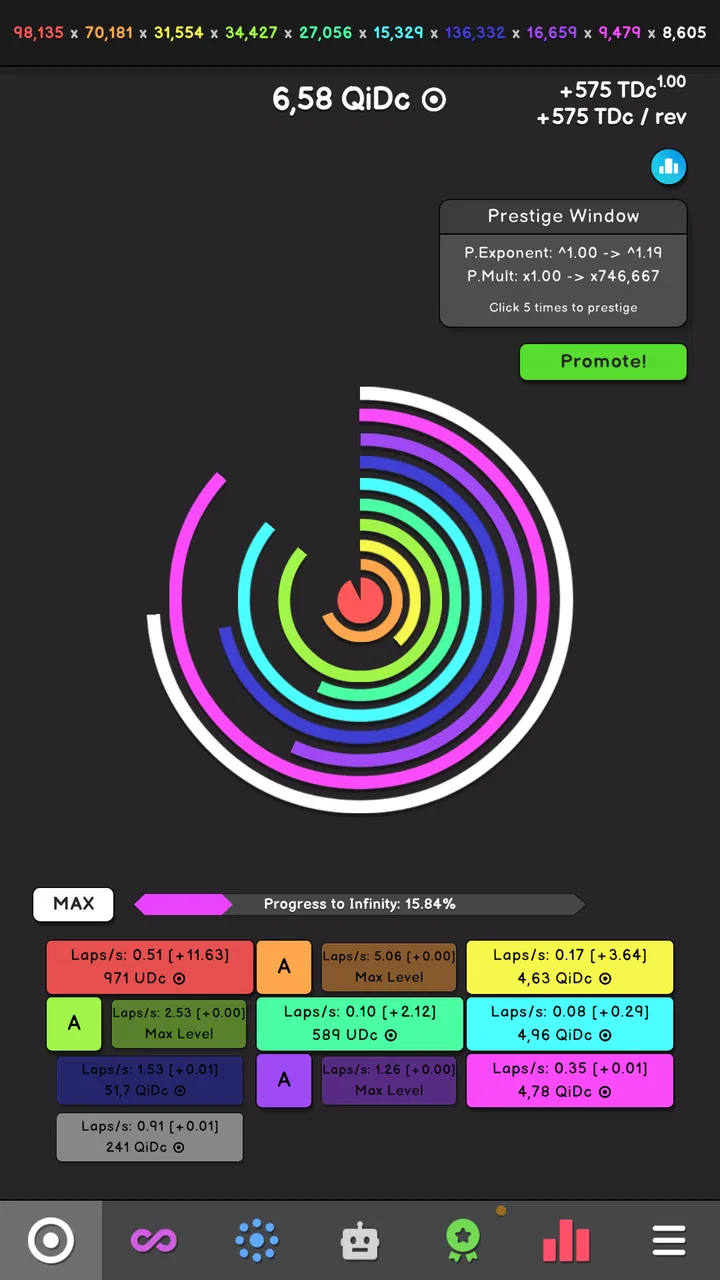
This is also where the game’s presentation works in its favor. Because the interface is not overloaded with action, I can focus on the relationship between choices and results. The downside is that players who need a strong sense of spectacle may find the later stages visually or emotionally quiet. The reward is more intellectual than dramatic: I understand the system a little better, and my next plan is more informed than the last one.
For a free game, the long-term question naturally includes the optional purchases, which range from $0.99 to $99.99 per item. I treated them as optional rather than as a requirement for understanding the core loop. My advice is to play long enough to decide whether the slow planning itself is enjoyable before spending anything. If the waiting and optimization already feel rewarding, a purchase may feel like convenience. If the basic pace feels dull, paying will not solve the underlying mismatch.
That is an important boundary. I would not recommend spending simply to remove the feeling of waiting unless the game has already earned your trust through enjoyable decisions. Idle games can make acceleration tempting because progress is intentionally gradual. I found it healthier to regard patience as part of the design, not as a problem that must automatically be paid away.
Who should choose it, and who should look elsewhere
I would recommend this game to someone who likes watching a system grow while making occasional, meaningful adjustments. It suits players who enjoy planning around real life, comparing short-term gains with long-term value, and returning to see whether a previous decision worked. It is also a good fit for someone who wants a simulation game that does not require fast reflexes or a fixed daily appointment.
I would be more cautious recommending it to a player who needs a strong narrative, direct competition, or constant manual control. The game does not offer the same kind of satisfaction as a city builder where I place every structure, a management game with a busy schedule of staff and customers, or an action title where skill is measured through timing. Those alternatives are better when the fun comes from visible activity rather than patient accumulation.
It may also be a poor match if you dislike delayed feedback. Some decisions take time to judge, and the game does not always provide the instant emotional confirmation that a traditional upgrade screen offers. I had to accept that a good choice might initially look unimpressive. If that kind of uncertainty feels like inconvenience rather than strategy, the idle format will probably wear thin.
The Everyone content rating makes it broadly accessible, and the low operating-system requirement means it can run on older Android devices from version 6.0 onward. Even so, accessibility does not mean universal appeal. The important question is whether you enjoy a calm progression loop where the main opponent is inefficient planning. That is the game’s real personality.
My final strategy verdict
After spending time with it, I see Revolution Idle as a thoughtful simulation game disguised as a very simple one. Its strongest feature is not the promise of endless growth by itself. It is the way that promise makes me consider timing, opportunity cost, and the difference between a satisfying purchase and a genuinely useful one. The game gives me space to make mistakes without turning every experiment into a disaster.
My best advice is to play in two modes. During short visits, make one deliberate adjustment and avoid spending resources just because they are available. Before a long absence, choose the plan that remains valuable without your attention. That small routine turns idle time into a strategic tool and prevents the game from becoming a sequence of automatic clicks.
The weaknesses are closely tied to its strengths. Its calm pace can feel empty, its repetition may test your patience, and optional purchases can make acceleration tempting. Compared with more active simulation games, it offers less direct control and less visual drama. But if you enjoy gradual systems and the quiet satisfaction of seeing a plan mature, those limitations become part of the appeal rather than deal-breakers.
Oni Gaming has made a free game that is easy to start but more reflective than I expected. I would install it for relaxed, long-term progression rather than for a burst of excitement. The store summary asks whether I can reach infinity; my more practical answer is that the journey is worthwhile when I enjoy deciding how to get there. For the right player, that is enough to make this a rewarding addition to an Android game library.
FAQs for Revolution Idle
01What is Revolution Idle and how does the gameplay work?
Revolution Idle is an incremental idle game focused on building and optimizing a constantly growing economy of resources. You begin with simple production systems, then unlock upgrades, multipliers, automation, prestige-style mechanics, and additional layers of progression. The game is designed for short check-ins as well as longer sessions, since progress can continue while you are away from the app.
02Can I play Revolution Idle without an internet connection?
Revolution Idle is generally designed to support idle progression, making it suitable for players who do not want to remain connected constantly. However, some features may depend on an internet connection, including advertisements, cloud saves, purchases, updates, or account-related services. Before traveling or playing offline for a long period, it is sensible to open the game online and confirm that your latest progress has been saved.
03Is Revolution Idle free to download and does it contain advertisements?
Revolution Idle can typically be downloaded and played for free, but the free experience may include optional or rewarded advertisements. These ads can sometimes provide bonuses, speed up progress, or offer additional resources. Depending on the version and platform, the game may also offer in-app purchases, such as removing advertisements or buying optional advantages. Check the store listing for the current pricing and purchase details.
04Is Revolution Idle suitable for beginners who are new to idle games?
Yes, Revolution Idle is approachable for beginners because its early systems are introduced gradually and the basic objective is easy to understand: generate resources, purchase improvements, and unlock stronger production options. Nevertheless, the game becomes more strategic as several upgrade paths and reset mechanics appear. New players should experiment with different upgrades instead of spending every resource immediately, especially when planning long-term progress.
05Does Revolution Idle include cloud saving or cross-device progress?
Progress-saving options can vary according to the device, operating system, game version, and account services available at the time of download. Some versions may support cloud synchronization, while others may rely mainly on local device storage. Before deleting the app, changing phones, or resetting your device, review the in-game settings and backup options carefully. Do not assume that progress will transfer automatically between Android and iOS.
Pros
- Simple idle gameplay is easy to understand and start playing.
- Offline progress lets you earn resources even when you are away.
- Multiple upgrade paths provide satisfying long-term progression.
- Minimalist visuals keep the interface clean and easy to navigate.
- Frequent rewards encourage short
- regular play sessions.
Cons
- Progress can feel slow without watching ads or making purchases.
- The repetitive gameplay may not appeal to players seeking active control.
- Limited visual variety can make extended sessions feel monotonous.
- Some upgrades require considerable time before their benefits are noticeable.
- Notifications and reward prompts may become distracting over time.

Revolution Idle
Gallery